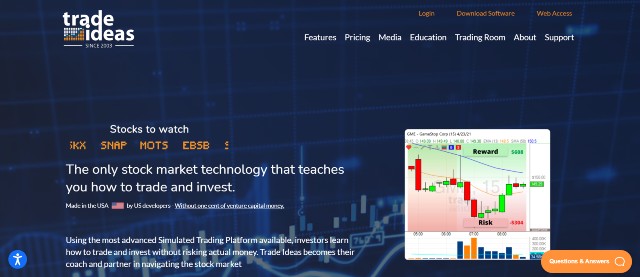
The User Interfaces and user experiences are crucial to the usability of AI trading platforms that predict and analyze stocks. A poorly-designed interface can inhibit the process of making decisions, even when AI models that underlie it are robust. Here are the top 10 tips for evaluating UI/UX.
1. Evaluate Intuitiveness and Ease of Utilization
Navigation: The platform must be user-friendly. It should be clear menus, buttons, and workflows.
Learning curve: Determine the speed at which a novice user can comprehend and utilize the platform, without requiring extensive training.
Check for consistency in designs across different platforms (e.g. buttons styles and colour schemes).
2. Check for Customizability
Dashboard customization: See if dashboards can be customized to display charts, data and other metrics that are relevant to the user.
Layout flexibility - Ensure that the platform permits users to resize or rearrange widgets and charts.
Themes: Determine whether your platform supports dark or light mode, or other preferences.
3. Review Data Visualization
Chart quality: Ensure the website offers interactive charts of high quality (e.g. candlestick charts lines charts, etc.)) with zoom and pan functions.
Visual clarity - Examine to ensure that data is displayed clearly, using appropriate labels, legends or tooltips.
Real-time updates: Check if the visualizations are updated in real-time to reflect any changes in the market.
4. Test for Reactivity and Speed
Loading Times: Make sure that your platform is loaded quickly even when you're managing large amounts of data.
Real-time performance: Make sure your platform is able to process data feeds instantly without delay or lags.
Cross-device compatibility: Make sure that the platform is compatible with all devices, including desktop, mobile and tablet.
5. Examine Accessibility
Mobile app availability: Check whether the platform provides an app on mobile that includes all the features needed for trading on the go.
Keyboard shortcuts. Check to see if the platform provides keyboard shortcuts for users who are skilled.
Accessibility features: Check that the platform meets accessibility standards (e.g. screen reader support, high-contrast modes).
6. Examine the Search and Filter Functions
Searching functionality: Ensure that the platform allows you to search quickly for indexes, stocks, and other assets.
Advanced filters: Determine if users can apply filters (e.g., by market cap, sector or performance indicators) to narrow down results.
Saved searches: Check whether you can save filters and searches that are frequently used.
7. Be sure to check for alerts and notifications
Customizable alerts. Users should be able to set alerts for certain circumstances (e.g. price thresholds or spikes in volume).
Notification Delivery: Examine to see if notifications are delivered in multiple ways (e.g. via SMS, email or app notifications).
Verify the promptness and the accuracy of alerts.
8. Connect to other tools
Broker integration: Ensure the platform integrates seamlessly with your brokerage account for simple trade execution.
API access: Find out whether the platform permits advanced users to develop custom tools and workflows.
Third-party integrations : Determine whether the platform supports integration with other software, like Excel, Google Sheets or trading bots.
9. Assess the Support and Help Features
Tutorials for onboarding Make sure that new users have the ability to access tutorials.
Help center - Ensure that the platform comes with an extensive support center or knowledgebase.
Customer service: Examine to see if the platform provides prompt customer service.
10. Test Overall User Experience
User feedback: Conduct research and testimonials in order to gauge the satisfaction of customers.
Trial period: Take advantage of an unpaid trial or demo to experience the platform firsthand and test its effectiveness.
Error handling: Examine how the platform handles errors or edge cases (e.g. incorrect inputs or downtime of servers).
Bonus Tips:
Aesthetics are important, an attractive design can improve the user's experience.
Performance under pressure: Test the platform during high-volatility market conditions to ensure that it is solid and agile.
Community and forums Forums and community: Find out whether the platform provides an online community or forum that allows users to discuss tips and feedback.
Follow these tips and you can evaluate the UI/UX of AI-based stock prediction and analysis trading platforms. They will be user-friendly and efficient and also suited to your trading needs. The user interface and experience of a trading platform can be a major factor in your ability to make informed trades and take the most effective choices. View the most popular view website on ai company stock for website tips including stock research, best ai companies to invest in, stock analysis, ai investing, best stock websites, ai companies to invest in, chat gpt stock, stock tips, stock market ai, artificial intelligence companies to invest in and more.

Top 10 Suggestions For Evaluating The Quality And Reliability Of Ai-Based Stock Trading Platforms
To ensure AI-driven stock prediction and trading platforms can scale as well, they should be able to cope with the growing volume of data and complexity in markets, and also user demands. Here are the top 10 suggestions on how to assess the scalability.
1. Evaluate Data Handling Capacity
Tip: Check if the platform can analyse and process large data sets (e.g., historic stock data, real-time market feeds, or alternative data such as news and social media).
Reason: Scalable platforms are required to handle increasing data volumes without performance degradation.
2. Test the Real-Time Processing Capabilities
Check out how well your platform can handle live streams of data in real-time such as live stock quotes, or breaking news.
Why: Analyzing in real-time is crucial for trading decisions, and delays could result in missing opportunities.
3. Cloud Infrastructure and Elasticity: Check it out
TIP: Check whether the platform utilizes cloud-based infrastructure (e.g., AWS, Google Cloud, Azure) and can scale resources dynamically.
Why: Cloud platform elasticity allows the size of the system to adapt based on usage.
4. Algorithm Efficiency
Tip 1: Examine the computational efficiency of the AI models being used (e.g. reinforcement learning, deep learning, etc.).
The reason: Complex algorithms may be resource-intensive, therefore optimizing them is key to scalability.
5. Explore the possibilities of Parallel Processing and Distributed computing
Tips: Find out if a platform is able to use parallel processing or distributed computing frameworks.
Why: These technologies enable faster data processing and analysis across a variety of nodes.
Examine API Integration, and Interoperability
Tip : Make sure the platform can integrate with other APIs, like brokers and market data providers. APIs.
What's the reason? Seamless integration guarantees the platform can adapt to the latest data sources and trading environments.
7. Analyze User Load Handling
To test the effectiveness of your platform, try simulated high traffic.
What's the reason? A platform that is scalable should be able to keep up with performance as the number of users increases.
8. Evaluate the model's retraining and adaptability
Tips: Examine how often and efficiently AI models are trained with new data.
The reason is that markets are always changing, and models have to adapt quickly in order to remain accurate.
9. Examine fault tolerance and redundancy
Tip. Make sure that your platform is equipped with failover systems and redundancy to handle hardware or software problems.
Why: Because downtime is costly in trading, fault tolerance is crucial for scalability.
10. Monitor Cost Efficiency
Tips: Think about the costs of scaling your platform. Take into account cloud resources such as storage of data as well as computing power.
Why: Scalability should not result in an unsustainable price which is why balancing performance with expense is critical.
Bonus Tip: Future-proofing
Make sure the platform is able to incorporate the latest technologies (e.g. quantum computing or advanced NLP), and is able to adapt to regulatory changes.
These aspects can assist you in assessing the scaleability of AI-powered stock prediction and trade platforms. They'll also be sure they're reliable and efficient capable of expansion and future-proof. Read the top rated chart ai trading for site recommendations including investing with ai, investing with ai, ai software stocks, free ai tool for stock market india, best ai trading platform, best ai trading platform, ai stock price prediction, how to use ai for stock trading, free ai tool for stock market india, investing with ai and more.